
Read the Niagara County Wanted Fugitives List
The Sheriff's warrants page is the county's official lookup tool. It doubles as the closest thing Niagara County offers to a wanted-fugitives list. Expect a search box and alphabetical sorting. The listing has held 166 entries across 17 pages, ten per page, though those numbers shift because the Sheriff posts no fixed update promise.
There is no photo-based most-wanted gallery. The warrant list itself carries no booking photos either. Treat it as a text and physical-description resource. Faces simply are not part of the picture. The county jail roster is a separate system, and it answers a different question about who is in custody now.
The Sheriff warrant-interface capture below shows the official search page itself, not one person's record or a gallery of faces. It helps a reader recognize the real listing before searching.
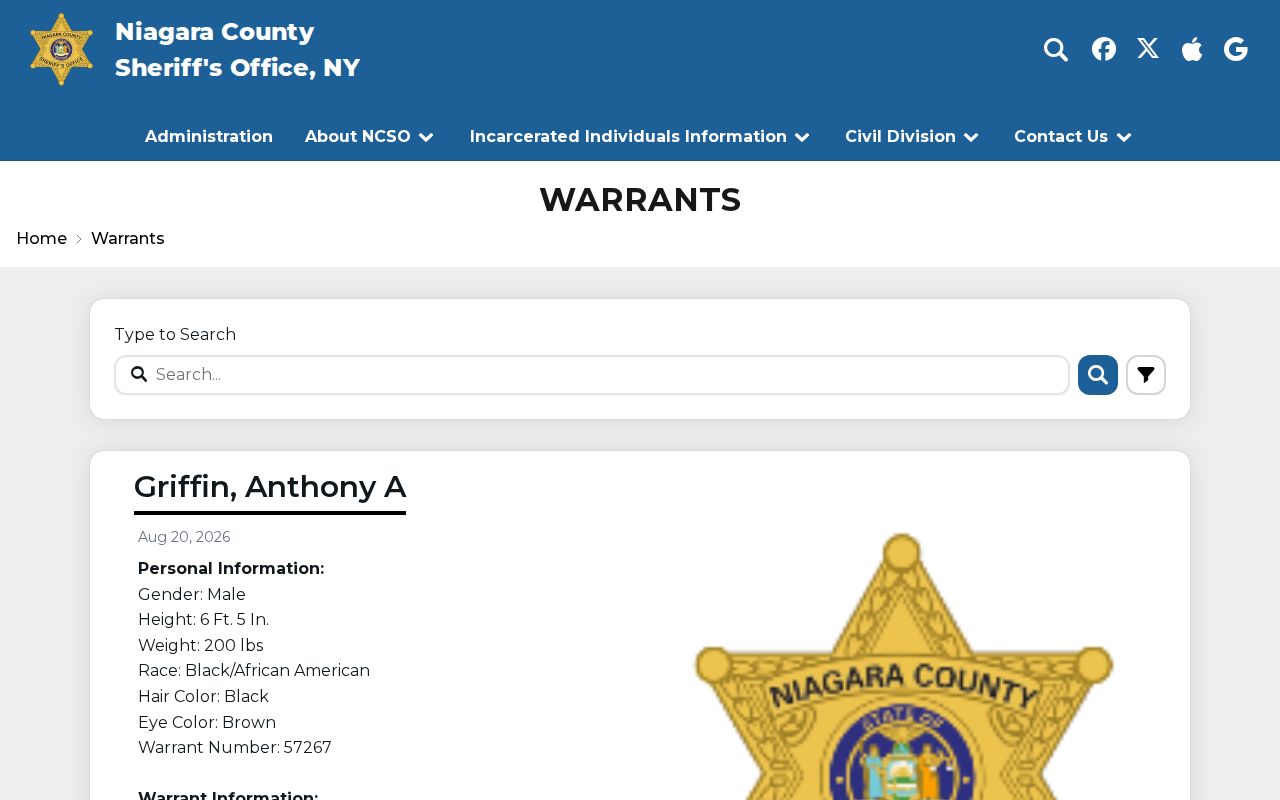
Searching a name against the published entries is easy. But visible contents cannot establish that every warrant stays active, or that the named person sits in jail right now. Only officials can answer those questions.
Niagara County Warrant Listing Fields
The Sheriff page gives enough detail to separate people with similar names, though it stops short of a full court file. Read each visible field with care. When a result concerns a real person, contact the office that holds the record before drawing any conclusion. The list supplied the fields below.
| Field | What the public list shows |
|---|---|
| Name | The name used in the published warrant entry. |
| Gender | A listed physical-description attribute, not a substitute for identity confirmation. |
| Height and weight | Physical descriptors shown with the entry. |
| Race, hair, and eyes | Additional description fields that may help distinguish similar names. |
| Warrant number | The number displayed with the published entry. |
| Issued date and time | The date and time presented as the warrant issue information. |
| Statute description | The legal description presented by the warrant page. |
The list carries no booking photos. It also publishes no update schedule, no claim of covering every warrant, and no docket history. A statute description is not a case outcome.
The issue date and time help a caller point the warrants unit to one specific entry. They say nothing about whether service happened or the entry changed later. Matching several physical fields only narrows a question for officials. Names and descriptions overlap. Confirmation matters most with common names, old dates, or information that may come from a different court.
Use the Niagara County Warrant List Safely
A published listing is a narrow tool. Use it to spot a possible official record, not to act against another person. Keep the search, the report, and any follow-up with the Sheriff or the court, and the process stays safe.
- Open the official Sheriff warrant page and use the search field or alphabetical listing to locate a possible match.
- Compare the name with the published physical-description fields, warrant number, issued date/time, and statute description.
- Do not approach, follow, confront, or try to detain a person based on a listing.
- For information about a possible location or identity, use the Sheriff’s official tip route or New York Crime Stoppers. Call 911 when there is immediate danger.
- For a post-arrest custody question, check the county-wide official roster and booking-record guide; a warrant page does not show current jail custody.
Tip channels are not for personal records or rumor-testing. The Sheriff's tip page and Crime Stoppers exist for public-safety information only. They cannot replace the warrants unit, a clerk, or a lawyer when someone asks about their own status. Keeping those purposes straight also prevents a current-custody roster result from being mistaken for an unexecuted warrant.
Check a Niagara County Warrant
A web search is just the first step when the result touches the person searched or a live legal matter. The Niagara County Sheriff's warrants unit answers at (716) 438-3344. The unit, the issuing court, or an attorney can point to the right confirmation channel. A court or clerk inquiry confirms a docket; the web list alone cannot prove a warrant still stands.
- Start with the published Sheriff warrant search and record the visible warrant number and issuing information.
- Call the warrants unit at (716) 438-3344 to ask what official confirmation path applies. Do not rely on an old screenshot or a third-party page.
- Contact the issuing court or its clerk for case-status information when the court is identified.
- For a personal legal concern or a claimed error, work through an attorney or the court. A surrender or resolution should be arranged through the court, an attorney, or the appropriate law-enforcement office.
The Sheriff's interface does not publish warrant categories. So the table below separates the documented channels instead of inventing labels, like a warrant "type," that the official source never uses.
| Documented channel | What it can help establish |
|---|---|
| Sheriff warrant page | A published warrant-associated entry and its visible fields. |
| Warrants unit | The appropriate official path to verify present status. |
| Issuing court or clerk | Case or docket status and the court connected to the matter. |
| County incarcerated search | Current county custody, which is distinct from wanted status. |
Once an inquiry is verified, venue matters. Lockport City Court, Niagara Falls City Court, and North Tonawanda City Court handle local criminal matters and preliminary felony processing in their areas. Niagara County Court in Lockport covers felony-level county matters and related criminal services. The New York Courts directory names the right venue and lists certificate-of-disposition services. For later case results, the court record is the source, not the public warrant list.
The warrant list still works as a public safety lead. It just answers a different question than the court file does. It cannot track procedural developments, charge changes, or final results. Ask the clerk or an attorney which court holds the record before trusting a name match.
Niagara County Tips and Crime Stoppers
Two tip routes exist in Niagara County. The Sheriff's Office runs an official Submit a Tip page for leads on wanted persons and other matters. New York Crime Stoppers offers a second option. Its statewide network includes a round-the-clock hotline, anonymous reporting, and the chance at a reward. Neither service does everything, though. Tips go in one direction. Staff may act on what you send, but they will not confirm an arrest, clear a warrant, or share private court details with callers.
Niagara County Sheriff
Use the official online Submit a Tip route for non-emergency information.
New York Crime Stoppers
Anonymous-tip and reward infrastructure is available around the clock.
(866) 313-TIPS (8477), 24/7
Keep a tip useful and factual. Names, locations, vehicles, and times help officials weigh what you saw. That is where your job ends.
Wanted Status and Niagara County Custody
The Sheriff's warrant page shows who is wanted, not who is locked up. A person listed there may have been arrested in another county, may not be at the Niagara County Correctional Facility at all, or may need a direct status check from the warrants unit. The reverse happens too. Someone in the current-custody roster might never appear on the warrant page, because the warrant was served, the status shifted, or the booking came about for a different reason.
The Sheriff's app deserves the same careful read. Niagara County Sheriff NY offers booked-inmate information, alerts, road closures, confidential tips, and bail-related tools, and an Android version sits on Google Play. No photo is promised for every person, and no historical warrant archive is tucked inside. For photos of people currently held, the web roster remains the official source.
Facebook and X posts from the Sheriff can carry public-safety notices and tip requests. They are not full arrest feeds. When you need arraignment dates or case outcomes, the court record is the layer that answers those questions.
The Sheriff homepage itself splits its tools apart. A crime-data dashboard, sex-offender registry, press releases, warrants, and an incarcerated search each sit under their own heading, and each covers a different population. A dashboard shows aggregate incidents. A registry is not a roster. A warrant page is not a court-clearance certificate. Keeping those labels straight keeps you from reading more into a public notice than the source supports.
If a wanted person is later booked into the Niagara County Correctional Facility, the custody roster will eventually reflect that with its own booking details. The roster does not work backward, though. It will not verify old warrant entries, and someone released from custody can drop off the list while the court case grinds on. Read the warrant list, roster, press releases, app notices, and court records as separate layers, not one merged history.
Each roster card can include booking date and time, physical descriptors, charges, and bail. That answers who is in custody right now. Release dates, court appearances, and outcomes live elsewhere. Warrant questions go to the warrants unit; case questions go to the court.